
Gemini 4 Argon Just Launched: What It Means for AI Automation in 2026?
Google has launched Gemini 4 Argon, its new frontier model for complex multi-step work, and n8n is already supporting it across agents and automation workflows. Here is what the release actually changes for businesses building AI automation — and where a traditional workflow is still the better choice.

IN THIS ARTICLE Table of contents 11 sections
Google has released Gemini 4 Argon, and for businesses building AI automation, the more interesting news is not simply that another frontier model has arrived.
n8n is already integrating it.
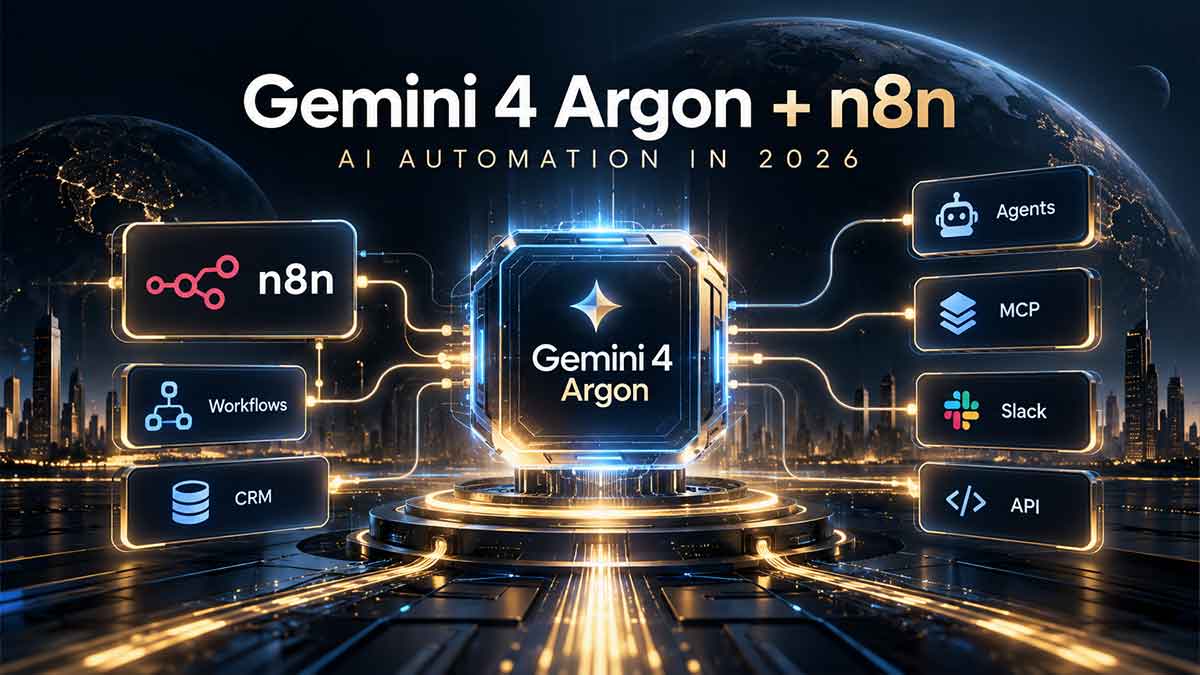
Google announced Gemini 4 Argon on October 13, 2026 as a model designed for complex, real-world, multi-step work across areas including software engineering, enterprise knowledge work, cybersecurity, finance and science. On the same day, n8n said it was among the first companies to integrate the model, making Argon available for n8n Agents and through the Google Gemini node from launch. blog.google
That combination is worth paying attention to because it reflects a larger change in business automation.
Until recently, most automations were designed as fixed paths:
Trigger → Action → Condition → Action
That model is still extremely useful.
But AI agents add another layer. Instead of defining every individual decision in advance, you can give an agent a goal, a set of approved tools and enough context to determine which step should happen next.
Gemini 4 Argon is being positioned specifically for this kind of longer, more complicated work.
The opportunity is not to replace every workflow with AI.
It is to identify the parts of a business process where judgement is difficult to express as a simple IF statement, while keeping the rest of the system predictable.
What is Gemini 4 Argon?
Gemini 4 Argon is the new flagship reasoning model in Google's Gemini 4 family.
Google describes it as a model designed for complex workflows that require deep reasoning and structural precision. It supports text, images, video, audio and PDF inputs and has a unified context window of up to roughly one million tokens. The API also supports features including function calling, structured outputs, code execution, Search grounding and computer use in preview. Google DeepMind
That combination matters for automation.
A traditional language model might be asked to summarise one customer email.
A stronger agentic model might need to read a long email thread, inspect attached documents, query a CRM, compare the information with internal policies, choose the correct next action and return structured data that another workflow can process.
Those are very different workloads.
Google says Argon is intended for these longer and more complicated tasks rather than simple one-shot prompts. blog.google
The important distinction for a business owner is that a better model does not automatically produce a better automation.
The Workflow Architecture around the model still matters.
Why the n8n integration is more interesting than the model launch alone
A powerful AI model is useful.
A model that can safely interact with the systems a business already uses is significantly more useful.
This is where n8n enters the picture.
According to n8n, Gemini 4 Argon can already be used as the reasoning model behind an n8n Agent. The agent can then use whichever tools you explicitly give it access to, including n8n nodes, APIs and sub-workflows. n8n Blog
Imagine a support agent.
It receives an incoming customer message.
The Agent reads the message, retrieves the customer's CRM record, checks internal help documentation, decides whether it has enough information to answer and either drafts a response or escalates the issue to a human.
The Agent is not given unrestricted access to everything.
Its available tools are defined by the Workflow.
That is an important architecture pattern.
AI handles interpretation and judgement.
n8n controls access and execution.
For businesses, that is usually much more useful than an AI system that has broad access to company tools with poorly defined boundaries.
Gemini 4 Argon can also build n8n workflows through MCP
Another interesting part of the announcement is n8n's use of Model Context Protocol, or MCP.
n8n provides a built-in MCP server that can connect compatible AI tools to an n8n instance. This means a developer can work inside an AI coding environment and ask the assistant to create an automation without manually building every Node.
n8n gives an example where a developer building a signup form can ask an agent to create a workflow that captures the Webhook, adds the new user to a CRM and sends a Slack welcome message.
The agent can build and test the Workflow inside n8n.
Importantly, n8n says the process stops before publishing and asks the human first. n8n Blog
That small detail matters.
The goal of AI-assisted Automation should not be removing humans from every decision.
A better goal is removing repetitive construction work while keeping approval around actions that can affect Production.
This is a much more realistic model for professional AI automation.
The n8n Assistant can use Argon too
n8n also has its own Assistant for building, editing, testing and debugging workflows through natural language.
For Self-hosted installations, n8n currently explains that Gemini can be reached through an OpenAI-compatible endpoint or another supported route when using Bring Your Own Key. On n8n Cloud, workflows can use Gemini 4 Argon through Gateway credits. n8n Blog
The practical effect is that building a Workflow is gradually becoming less dependent on remembering exactly which Node and configuration field should be used.
You can describe the intended business result.
The Assistant can help construct the initial Workflow.
A developer can then review the Nodes, error handling, credentials, security boundaries and Business Logic before publishing it.
That changes the economics of certain Automation projects.
It may take less time to produce the first working version.
But it does not remove the need to understand the system.
A Workflow that is generated faster can still be badly designed faster.
Where Gemini 4 Argon could actually help a business
The strongest applications are probably not tasks where a normal automation already works perfectly.
Consider a basic lead form.
The user selects:
Service: SEO
Budget: $5,000–$10,000
Timeline: 1–3 months
A normal IF or Switch Node can route that Lead.
There is little reason to pay for a frontier reasoning model to determine something the form has already expressed clearly.
Now consider a different submission:
“Our traffic has been falling since we rebuilt the site. We are not sure whether the problem is the migration, the new theme or the content. We have around 12,000 product pages and want someone to investigate before our holiday campaign.”
This is a much more interesting AI task.
The model can extract several signals from unstructured text:
SEO problem likely related to migration, large website, ecommerce context, high urgency and a need for technical investigation.
n8n can then apply deterministic rules to the structured result and decide how the Lead should be handled.
This principle applies well beyond Lead Generation.
Customer-support messages, long documents, internal requests, research, proposal preparation and workflows involving several data sources all contain areas where reasoning can provide value.
The model should handle the messy part.
The Workflow should handle the predictable part.
AI Agent or traditional Workflow?
This is probably the most important question businesses should ask after the Argon launch.
| Situation | Better starting point |
|---|---|
| Copy data from one system to another | Traditional Workflow |
| Send an alert when a condition is met | Traditional Workflow |
| Validate a known field | Traditional Workflow |
| Categorise a complex free-text request | AI-assisted Workflow |
| Research across several sources | Agent |
| Choose between tools based on changing context | Agent |
| Execute sensitive financial action | Workflow + approval |
| Draft a response from CRM and knowledge-base context | Agent with controlled tools |
The temptation with every new model release is to put AI everywhere.
That usually increases Cost and Complexity.
If a deterministic Rule can perform a task accurately every time, replacing it with a probabilistic model often makes the system less predictable.
Gemini 4 Argon's value is more likely to appear in places where the Workflow previously needed a human to interpret information.
The one-million-token context window matters — but not for every automation
Gemini 4 Argon supports a unified input-output context of up to around one million tokens through the Gemini API. Google AI for Developers
For simple workflows, this is irrelevant.
A CRM Lead record might contain only a few hundred tokens.
But large context windows become more interesting when an Agent needs to work across significant amounts of information.
For example, a business could potentially combine project documentation, CRM history, contracts, meeting notes and internal knowledge while processing a complex request.
The engineering challenge then changes.
The question is no longer just whether the Model can read all the data.
It is whether sending all that data is necessary, cost-effective and safe.
Large context should not become an excuse to send an entire company knowledge base into every Workflow execution.
Good Automation still requires selecting the right context.
What does Gemini 4 Argon cost?
Google launched the public Argon model with introductory API pricing of $2 per million input tokens and $10 per million output tokens.
Google says that introductory period runs until November 30, 2026, after which the listed price becomes $4 per million input tokens and $20 per million output tokens. Cached input tokens receive a substantial discount during the introductory pricing period. blog.google
That pricing needs to be considered at Workflow level.
A Workflow running ten times per day with short inputs has a completely different cost profile from an Agent processing large documents thousands of times.
This is why AI Automation should be measured using cost per useful outcome, not simply monthly API spend.
If an Agent costs a few cents but saves twenty minutes of skilled human work, the economics may be excellent.
If it costs money to make a decision that a normal IF Node could make for free, the design should probably be reconsidered.
The benchmark numbers are interesting, but businesses should not buy on benchmarks alone
Google reports strong results for Argon across several evaluations.
Its model card lists a score of 68.9% on the Vals Index and 51.3% on AutomationBench, alongside results for coding, long-context tasks, computer use, multimodal understanding and other categories. Google DeepMind
Those numbers are useful for understanding where the model may be strong.
They should not be treated as a guarantee that Argon will outperform every other model inside your specific business process.
Your Workflow might require perfect JSON consistency.
Another process might care primarily about latency.
One company might need excellent Persian-language understanding.
Another might be processing long technical documents.
A production decision should therefore be based on your own Evaluation Set.
Give several candidate models the same real tasks.
Measure output quality, latency, cost, failure rate and the amount of human correction required.
The best benchmark for your Automation is your Automation.
Better AI does not remove the need for guardrails
Google has also highlighted improvements around Agent safety, prompt-injection resistance and respecting system boundaries in Argon. Its announcement says the model was trained to avoid unauthorized shortcuts and pause for human confirmation before irreversible actions in certain scenarios. blog.google
Those improvements are important.
They are not a reason to remove application-level security.
If an n8n Agent can access a CRM, Email, Slack and an internal database, the Workflow should still determine exactly what the Agent is allowed to do.
A Customer Support Agent may need permission to read a CRM record.
It probably does not need permission to delete the customer.
A Reporting Agent may need to query a database.
It may not need write access.
Human approval should remain around high-impact or irreversible actions where appropriate.
Good Agent design combines Model Capability with System Controls.
What this release actually means for AI Automation
Gemini 4 Argon will not suddenly make every company an autonomous business.
That is not the interesting part of the announcement.
The more meaningful change is that reasoning models and Automation platforms are getting closer together.
n8n is no longer only an environment where developers manually connect fixed Nodes.
Agents can now sit alongside deterministic workflows.
MCP can let AI systems construct Workflows.
Assistants can help debug them.
Models such as Gemini 4 Argon can handle parts of a Process that previously required much more custom logic or manual interpretation.
The result is a new type of Automation Architecture:
Rules where certainty matters.
AI where interpretation matters.
APIs where systems need to communicate.
Human approval where consequences matter.
That is far more useful than simply attaching an LLM to every Workflow.
For businesses already using Website forms, CRM systems, internal tools or repetitive manual processes, the question after the Gemini 4 Argon launch should therefore not be:
“How can we use Gemini?”
A better question is:
“Which part of our current process still requires human interpretation, and could an AI-assisted Workflow handle that part safely?”
That question leads to useful Automation.
If you are exploring AI Agents, n8n, CRM Automation or a custom Workflow, you can review the broader [services](/#services) and [portfolio](/#portfolio). If you want to evaluate a real business process rather than start from a specific AI tool, [send the workflow and the systems involved](/#contact) and the architecture can be assessed before deciding whether Gemini 4 Argon, another model or a traditional n8n Workflow is the better fit.