
Good SEO Is Good GEO: How to Build Visibility in AI Search?
Discover why good SEO is good GEO and how authoritative content, search intent, user experience, and trust drive visibility in AI search.

IN THIS ARTICLE Table of contents 16 sections
However, one important principle remains unchanged:
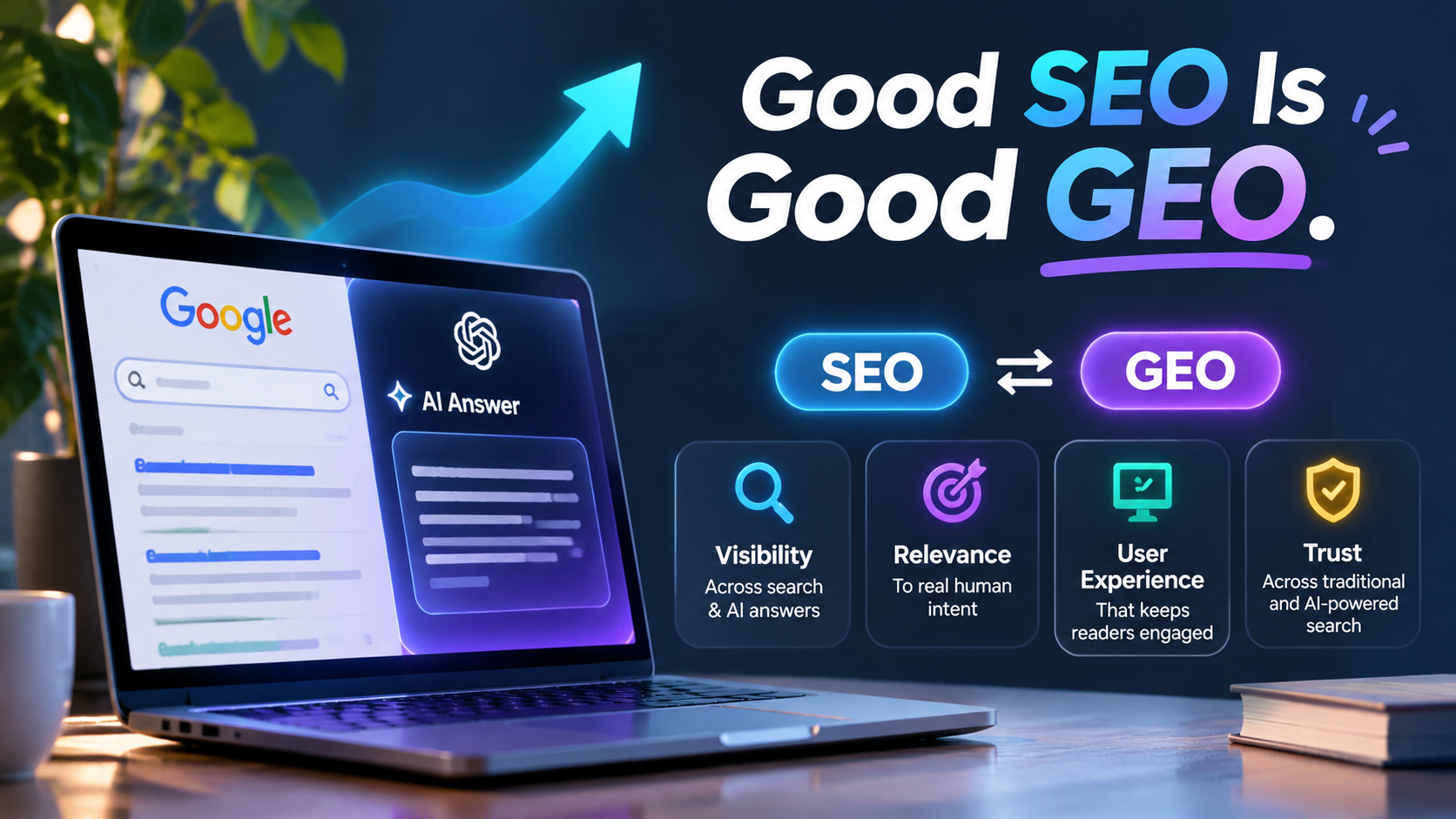
Good SEO is good GEO.
This was a major takeaway from Google Search Central Live Bengaluru 2026, highlighting an important shift in the future of search: businesses and content creators should focus not only on traditional search rankings but also on visibility, relevance, user experience, and trust across AI-powered search experiences.
Whether you call it Search Engine Optimization (SEO), Generative Engine Optimization (GEO), or AI Search Optimization, the foundation of sustainable search visibility remains the same: creating valuable, authoritative content that genuinely helps people.
Let's explore what this means and how businesses can adapt their content strategies.
What Is GEO (Generative Engine Optimization)?
Generative Engine Optimization (GEO) is the practice of improving how content is discovered, understood, and potentially surfaced in AI-powered search experiences.
Traditional SEO primarily focuses on improving a website's visibility in search engine results pages (SERPs). GEO expands this perspective by considering how generative AI systems retrieve, interpret, and present information when responding to user questions.
For example, users may search for a service through Google or ask an AI assistant to recommend the best solution for a specific business problem.
In both situations, useful, relevant, and trustworthy information matters.
GEO should not be viewed as a replacement for SEO. Instead, it represents an evolving approach to search visibility that builds on many established SEO principles.
Why Good SEO Is Still the Foundation of GEO
The emergence of AI-powered search does not make traditional SEO irrelevant.
In fact, many of the qualities that make a website successful in organic search also contribute to creating content that is useful in AI-driven discovery experiences.
Four principles are particularly important.
1. Visibility Across Traditional and AI Search
Online visibility is no longer limited to appearing among the top organic search results.
Users discover information through multiple experiences, including traditional search engines, AI-generated answers, and conversational search interfaces.
Businesses should therefore think beyond individual keyword rankings and develop a broader visibility strategy.
This means:
Creating content around relevant topics and user questions.
Building a consistent presence across important search experiences.
Developing useful resources that address different stages of the customer journey.
Maintaining a technically accessible and well-organized website.
The objective is to make valuable information easier to discover wherever users search.
2. Relevance to Real Human Search Intent
One of the most important SEO principles is understanding what users actually want when they search.
A page can target a valuable keyword and still fail if it does not answer the user's real question.
For example, someone searching for "WordPress development services" may want to understand:
What a professional WordPress development service includes.
How much a custom WordPress website costs.
Whether a custom theme is better than a page builder.
How to choose the right WordPress developer.
A successful content strategy should address these underlying needs rather than simply repeat keywords throughout a page.
To improve relevance:
Understand the intent behind each target keyword.
Answer important questions directly.
Provide meaningful explanations and practical examples.
Organize information around the problems users are trying to solve.
Content becomes more valuable when it reflects real human needs instead of focusing exclusively on search engine terminology.
3. User Experience That Keeps Readers Engaged
High-quality content is not just about what you write. It is also about how people experience it.
Even a technically optimized article can perform poorly as a user experience if it is difficult to read, confusing, or overloaded with unnecessary information.
A strong user experience should include:
Clear headings and logical content structure.
Readable typography and appropriate spacing.
Responsive layouts for mobile and desktop.
Fast-loading pages.
Helpful internal links.
Clear navigation and accessible content.
Good UX helps visitors find information efficiently and understand what to do next.
It also supports a stronger relationship between your website and its audience.
4. Building Trust and Authority
Trust is essential in both traditional and AI-powered search experiences.
People want information they can rely on, especially when making business decisions or choosing professional services.
Publishing large volumes of content without demonstrating expertise is unlikely to create lasting credibility.
Instead, businesses should focus on developing genuine authority within their areas of expertise.
Practical ways to strengthen content credibility include:
Sharing real project experience and case studies.
Providing accurate and useful explanations.
Demonstrating subject-matter expertise.
Keeping important information up to date.
Maintaining consistency across website content.
Supporting claims with relevant evidence where appropriate.
The goal is not simply to publish more content. It is to become a reliable source of information in your industry.
SEO vs GEO: Are They Really Different?
SEO and GEO have different areas of emphasis, but they share an important objective: helping users discover useful information.
| Aspect | Traditional SEO | GEO |
|---|---|---|
| Primary focus | Search engine visibility | Visibility in generative AI experiences |
| Content priority | Relevance and usefulness | Relevance, clarity, and usefulness |
| User interaction | Search results and website visits | AI-generated answers and discovery |
| Trust | Credibility and authority | Credibility and reliable information |
| Long-term foundation | Quality content and technical SEO | Quality content and established SEO principles |
These approaches should not be treated as competing strategies.
A website that invests in useful content, strong information architecture, technical accessibility, and genuine expertise is building a foundation that supports both traditional and emerging search experiences.
Importantly, GEO does not guarantee that a page will be cited or recommended by an AI system. Visibility depends on how individual systems retrieve, evaluate, and present information.
How to Prepare Your Website for the Future of Search
Businesses do not necessarily need an entirely new SEO strategy to adapt to AI search.
They need to strengthen the fundamentals and build a more comprehensive approach to content quality.
Here are five practical priorities:
1. Create genuinely useful content
Focus on solving real problems rather than producing articles simply to target additional keywords.
2. Build topical authority
Develop connected resources that demonstrate meaningful expertise across the subjects relevant to your business.
3. Improve content structure
Use descriptive headings, clear explanations, logical sections, and useful internal links to make information easier to navigate.
4. Invest in user experience
Make sure your website is responsive, accessible, fast, and easy to use.
5. Build credibility through experience
Use original insights, real project examples, and accurate information to demonstrate why visitors should trust your expertise.
These priorities provide a practical foundation for a search strategy that can evolve alongside new technologies.
The Future of SEO Is About More Than Rankings
The future of search is not simply about optimizing pages for a different type of algorithm.
It is about understanding how people discover information and ensuring that your content remains valuable across different search experiences.
Traditional SEO, Generative Engine Optimization, and AI Search Optimization may have different terminology and areas of emphasis, but they share a common foundation.
Visibility matters. Relevance matters. User experience matters. Trust matters.
Most importantly, content quality remains essential.
Businesses that focus on helping people, demonstrating expertise, and delivering meaningful digital experiences will be better positioned to adapt as search continues to evolve.
Good SEO is good GEO because both start with the same principle: create content that deserves to be discovered, trusted, and used.
Frequently Asked Questions
What does GEO mean in SEO?
GEO stands for Generative Engine Optimization. It refers to improving content discoverability and visibility in AI-powered search and generative answer experiences.
Is GEO replacing traditional SEO?
No. GEO should be considered an extension of an evolving search strategy rather than a complete replacement for traditional SEO. Established SEO principles remain important.
What is the difference between SEO and AI Search Optimization?
Traditional SEO focuses primarily on visibility in search engine results, while AI Search Optimization considers how content can be discovered and surfaced in AI-powered search experiences.
Does high-quality content help with GEO?
High-quality, relevant, and authoritative content provides an important foundation for both traditional search and AI-powered discovery. However, publishing quality content does not guarantee inclusion in AI-generated answers.
What should businesses prioritize for SEO and GEO?
Businesses should prioritize content relevance, genuine expertise, technical accessibility, user experience, and trust. These fundamentals support a sustainable approach to search visibility.
Final Thoughts
Search technology will continue to change, but the importance of valuable information will not disappear.
Instead of chasing every new SEO trend or treating GEO as an entirely separate discipline, businesses should invest in the fundamentals that make their websites genuinely useful.
The strongest long-term strategy is not simply to rank higher or appear in more AI-generated answers.
It is to become a trusted source that people and search experiences can rely on.