
WooCommerce Development Services: Custom Storefronts, Checkout & Integrations
Need expert WooCommerce development? Build a custom online store with optimized checkout, payment integrations, automation and scalable ecommerce solutions.

IN THIS ARTICLE Table of contents 39 sections
Build a WooCommerce Store That Does More Than Just Sell Products
Your online store should do more than display products and accept orders. It should make purchasing easy, support your business operations, and provide a reliable foundation for growth.
If you are looking for professional WooCommerce development services, I can help you build, customize, and improve an online store around your actual business requirements.
Whether you are launching a new ecommerce business, redesigning an existing WooCommerce store, improving your checkout experience, or connecting your store to external business systems, the goal is to create a solution that works for both your customers and your team.
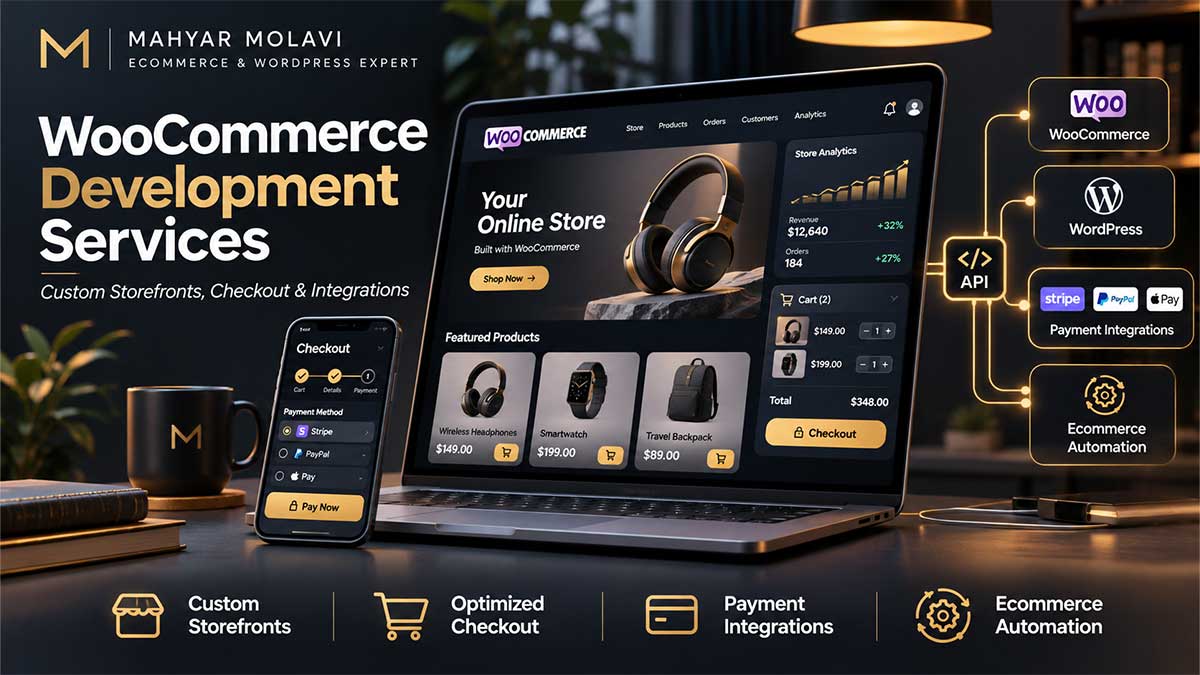
I focus on practical WooCommerce development, including custom storefronts, checkout customization, payment integrations, API connections, performance improvements, and ongoing technical support.
Need a WooCommerce developer for your next ecommerce project?
Request a WooCommerce Development Estimate
WooCommerce Development Services
Every ecommerce business has different products, customers, payment requirements, and operational workflows.
A successful WooCommerce project should reflect those differences instead of forcing your business into a generic store template.
Here are the main WooCommerce development services available for your project.
1. Custom WooCommerce Store Development
A professional online store needs a clear structure, intuitive navigation, and a shopping experience that makes it easy for customers to find and purchase products.
I help develop WooCommerce stores based on your brand identity, product catalog, and business requirements.
Development can include:
Custom WooCommerce store setup and configuration.
Storefront design and theme customization.
Responsive layouts for desktop, tablet, and mobile.
Product category and product detail page development.
Custom product attributes and variations.
Shopping cart and account functionality.
Custom shop pages and navigation.
WordPress and WooCommerce functionality improvements.
The objective is not simply to install WooCommerce and select a theme. It is to build an ecommerce experience that supports your products, customers, and sales process.
2. WooCommerce Checkout Customization
Checkout is one of the most important stages of an online purchase.
Customers may leave a store when the checkout process is confusing, requires unnecessary information, or does not provide the payment and delivery options they expect.
I can help improve your WooCommerce checkout experience by reviewing its structure and customizing the purchasing process.
Possible improvements include:
Custom checkout field configuration.
Simplified billing and shipping forms.
Checkout layout customization.
Cart and order summary improvements.
Coupon and discount functionality.
Shipping option presentation.
Payment method configuration.
Checkout error investigation.
Mobile checkout usability improvements.
Where appropriate, the implementation can use WooCommerce Cart and Checkout Blocks or a compatible classic checkout approach.
The choice depends on your theme, extensions, payment gateways, and required custom functionality.
The goal is to make checkout easier to understand and complete without compromising the reliability of order processing.
3. WooCommerce Payment Gateway Integration
A payment system must work correctly with your store's checkout, order management, and business requirements.
I can help configure or develop payment integrations based on the supported payment providers and technical requirements of your target market.
Payment integration projects may include:
Payment gateway configuration.
Custom payment gateway integration.
Payment status synchronization.
Order confirmation workflows.
Payment failure handling.
Refund workflow integration.
Webhook configuration.
Checkout compatibility testing.
For custom integrations, the implementation should account for payment confirmation, duplicate requests, failed transactions, and order status consistency.
Payment provider availability and regional restrictions must be verified before selecting the final solution.
A payment method should not simply appear at checkout. It should reliably communicate with the store and process orders according to the provider's requirements.
4. WooCommerce API Integration and Business Automation
As an ecommerce business grows, managing information across multiple platforms can become complicated.
Your store may need to communicate with a CRM, accounting platform, inventory management system, shipping provider, or marketing automation tool.
WooCommerce provides REST API and Store API capabilities that support different types of integrations.
I can help connect WooCommerce with external systems based on your operational needs.
Common integration projects include:
WooCommerce to CRM integration.
Product and inventory synchronization.
Order synchronization with external systems.
Customer data integration.
ERP and business management connections.
Shipping and fulfillment integrations.
Custom REST API development.
Webhook-based automation.
Automated order notifications.
Integration with business reporting tools.
For example, when a customer places an order, an integration can trigger a workflow that sends the relevant order information to another business system.
The exact workflow depends on the APIs, authentication requirements, data structures, and error-handling capabilities of the connected platforms.
The objective is to reduce repetitive manual work and create a more connected ecommerce operation.
5. WooCommerce Product Catalog and Store Management
Managing a large product catalog can become challenging, especially when a business sells hundreds or thousands of products.
A well-organized catalog helps customers find products and makes store administration easier.
Development and configuration can include:
Product category architecture.
Variable and simple product configuration.
Product attributes and filtering.
Product data imports.
Product image organization.
Bulk product management workflows.
Inventory synchronization.
Custom product fields.
Product search improvements.
For larger stores, the product data structure should be planned carefully to avoid unnecessary duplication and administrative complexity.
A good catalog is not just a collection of products. It is an important part of the customer experience.
6. WooCommerce Website Redesign and Migration
An outdated ecommerce website can make it difficult to introduce new features, maintain the store, or provide a modern shopping experience.
If your existing WooCommerce store needs a redesign or migration, the process should protect important functionality and business data.
Support can include:
WooCommerce store redesign.
Theme replacement and customization.
Migration from another ecommerce platform.
WordPress hosting migration.
Product and customer data migration.
Order history migration.
URL and redirect planning.
Plugin and integration compatibility checks.
Pre-launch testing.
Before migration, the existing store should be reviewed to identify important dependencies, custom functionality, payment configurations, and SEO-sensitive URLs.
The priority is to preserve essential store functionality while improving the technical foundation.
7. WooCommerce Speed Optimization and Performance Improvements
A slow online store can make shopping frustrating and affect the overall experience of your customers.
Performance optimization should address the actual causes of slow loading rather than relying on random plugins or superficial adjustments.
Depending on your store's condition, improvements may include:
Reviewing hosting and server configuration.
Database query optimization.
Image compression and delivery improvements.
Browser and server-side caching.
JavaScript and CSS optimization.
Plugin performance assessment.
Theme and custom code optimization.
Core Web Vitals investigation.
Performance testing on mobile devices.
Not every performance issue has the same cause.
A store with an overloaded database needs a different solution from one affected by oversized images or poorly optimized third-party scripts.
The first step should be identifying the bottlenecks and measuring the results of the improvements.
No specific PageSpeed score or performance result should be promised before testing the actual website.
8. WooCommerce Maintenance and Technical Support
An ecommerce store needs regular maintenance to remain reliable as its software, plugins, and business requirements evolve.
I can help with technical improvements and maintenance tasks such as:
WooCommerce and WordPress updates.
Plugin compatibility checks.
Bug fixing and troubleshooting.
Backup and recovery planning.
Checkout functionality testing.
Database maintenance.
Security configuration reviews.
Technical documentation.
Ongoing feature development.
For production stores, updates should be tested carefully before being applied to the live environment.
A staging environment and a clear recovery plan can help reduce the risk of unexpected disruptions.
Why Choose WooCommerce for Your Online Store?
WooCommerce is an ecommerce platform built on WordPress that allows businesses to manage products, orders, customers, and store functionality through an extensible system.
It can be a practical option for businesses that want flexibility over their online store and its development.
Here are some important advantages.
Flexible Store Customization
WooCommerce can be extended to support different product types, store layouts, customer workflows, and business requirements.
You are not limited to the functionality of a standard ecommerce template.
Extensive Integration Capabilities
WooCommerce provides developer APIs and extension mechanisms that make it possible to connect the store with external services and business applications.
This is particularly useful for businesses that need their ecommerce platform to work alongside other operational systems.
Control Over Your Ecommerce Infrastructure
With a self-hosted WordPress and WooCommerce setup, businesses have control over important parts of their website, hosting environment, and custom development.
This also means that hosting, backups, updates, security, and maintenance need to be managed properly.
Room for Future Development
A well-planned WooCommerce implementation can evolve as your business grows.
New payment methods, product features, integrations, and operational workflows can be introduced according to changing requirements.
However, the architecture and extension choices should be considered carefully to avoid unnecessary technical complexity.
WooCommerce Development for Digital Agencies: White-Label Partnerships
Do you run a web design agency, digital marketing company, or software studio that needs additional ecommerce development capacity?
I am also open to white-label development collaborations with agencies that need technical support for WooCommerce projects.
This model allows your agency to maintain the client relationship while I support the technical implementation according to our agreed scope.
What Can Be Included in a White-Label Partnership?
Depending on the project, collaboration can include:
WooCommerce store development.
Custom storefront implementation.
Checkout customization.
Payment and shipping integrations.
Custom functionality development.
API integrations.
Technical troubleshooting.
Store optimization and maintenance.
How Does the Collaboration Work?
1. Project requirements
Your agency shares the client brief, technical requirements, expected deliverables, and timeline.
2. Technical assessment
The project scope, dependencies, required integrations, and development effort are reviewed.
3. Development and implementation
The agreed technical work is completed according to the project milestones.
4. Testing and review
The implemented functionality is reviewed against the agreed requirements.
5. Handover
The agreed source code, documentation, and delivery materials are handed over.
Confidentiality, client communication boundaries, intellectual property, repository access, and responsibilities should be documented before the engagement begins.
Who Is This Partnership For?
Web design and development agencies.
Digital marketing agencies.
Ecommerce consultants.
Software development studios.
Agencies managing multiple WooCommerce projects.
Businesses needing external ecommerce development capacity.
If you need a development partner for ongoing or project-based ecommerce work, let's discuss the collaboration.
Discuss a White-Label WooCommerce Partnership
My WooCommerce Development Process
A successful ecommerce project needs more than good-looking pages. It requires a clear technical plan, careful implementation, and proper testing.
I follow a structured process to keep development aligned with your business objectives.
Step 1: Ecommerce Discovery
We begin by understanding your business model, product catalog, target customers, and operational requirements.
Important questions include:
What products do you sell?
Which countries do you serve?
Which payment methods do your customers need?
How do you manage inventory?
What shipping and delivery rules apply?
Which external systems need to be connected?
This information helps define the appropriate technical solution.
Step 2: Technical Planning and Scope Definition
The next step is translating business requirements into a development plan.
This includes defining:
Store structure and page requirements.
Theme and extension requirements.
Checkout and payment functionality.
Shipping and tax configuration.
API and external integrations.
Performance requirements.
Testing and deployment responsibilities.
The scope is agreed before implementation begins.
Step 3: Development and Customization
The store is developed or customized according to the agreed requirements.
Development focuses on functionality, responsive design, maintainable code, and compatibility with the selected WooCommerce components.
Where custom code is necessary, the implementation should be structured to support future maintenance.
Step 4: Testing and Quality Assurance
Before launch, the store should be tested through realistic shopping scenarios.
Testing may include:
Product selection and variations.
Cart functionality.
Coupon application.
Shipping calculations.
Checkout validation.
Payment gateway behaviour.
Order creation and status updates.
Email notifications.
Mobile usability.
Critical integrations.
Payment testing should use the appropriate test or sandbox environment where supported.
Step 5: Launch and Technical Handover
After the agreed testing and review process, the store can be prepared for production.
The handover may include source code, relevant configuration documentation, deployment notes, and instructions for managing the store.
Backup and rollback procedures should also be considered before major production changes.
How Much Does WooCommerce Development Cost?
The cost of WooCommerce development depends on the scope and complexity of your ecommerce project.
A basic store configuration is very different from a custom ecommerce platform with multiple integrations, advanced checkout logic, and specialized product functionality.
The main cost factors include:
| Development Area | What Affects the Cost |
|---|---|
| Store Development | Number of pages, design complexity and product structure |
| Custom Features | Business logic and specialized functionality |
| Checkout Customization | Custom fields, validation and payment requirements |
| API Integrations | Number of systems and integration complexity |
| Payment Integration | Provider requirements and transaction workflows |
| Migration | Data volume, URL structure and existing functionality |
| Performance | Hosting, database, theme and plugin issues |
| Maintenance | Support scope, update frequency and responsibilities |
I prefer reviewing your requirements before providing a project estimate.
Depending on the project, the engagement can be structured around:
Fixed-scope development projects.
Milestone-based delivery.
Ongoing technical support.
Agency and white-label partnerships.
This makes it easier to define deliverables, costs, responsibilities, and expected timelines before development begins.
Request a Custom WooCommerce Project Estimate
What Do I Need to Start Your WooCommerce Project?
To prepare a useful estimate, it helps to provide a few details about your business and technical requirements.
If you already have a store, sharing its URL can help identify the current structure and possible development requirements.
For a new store, useful information includes:
Your business type and product category.
Approximate number of products.
Target countries and currencies.
Required payment methods.
Shipping and fulfillment requirements.
Preferred design or reference websites.
Required third-party integrations.
Expected launch timeline.
You do not need a complete technical specification to get started.
A short project brief is enough to begin an initial discussion.
Frequently Asked Questions About WooCommerce Development
What are WooCommerce development services?
WooCommerce development services include building, customizing, integrating, optimizing, and maintaining online stores using WooCommerce and WordPress.
These services can include custom storefronts, checkout improvements, payment integrations, API development, product catalog management, migration, and technical support.
Can you build a custom WooCommerce store from scratch?
Yes. A WooCommerce store can be configured and developed around your brand, products, customer experience, and business requirements.
The final implementation depends on the required functionality, design scope, and technical specifications.
Can you customize the WooCommerce checkout page?
Yes. Checkout customization can include field configuration, layout improvements, validation, shipping options, and compatible payment integrations.
The appropriate implementation depends on whether the store uses the block-based or classic checkout experience and which extensions are installed.
Can WooCommerce connect to an external CRM or ERP?
Yes. WooCommerce APIs and integration mechanisms can support connections with external CRM, ERP, inventory, accounting, and business management systems.
The feasibility and development scope depend on the external platform's API and authentication requirements.
Can you integrate custom payment gateways into WooCommerce?
Custom payment gateway development may be possible when the provider offers suitable technical documentation and integration access.
The implementation must account for payment confirmation, error handling, order status updates, and compatibility with the store's checkout system.
Is WooCommerce suitable for large ecommerce stores?
WooCommerce can support a range of ecommerce business models, including stores with substantial catalogs and operational requirements.
However, scalability depends on hosting, database design, caching, plugin selection, custom code, traffic patterns, and ongoing maintenance.
The architecture should be evaluated according to the expected workload.
Can you improve an existing WooCommerce website?
Yes. Existing stores can be reviewed and improved without automatically rebuilding everything.
Depending on the situation, the work may involve troubleshooting, checkout improvements, performance optimization, integration development, redesign, or migration.
Do you offer white-label WooCommerce development?
Yes. White-label collaboration can be arranged for digital agencies and software studios that need additional ecommerce development capacity.
Project confidentiality, communication responsibilities, ownership, and deliverables are agreed before work begins.
How long does it take to develop a WooCommerce store?
The timeline depends on the store's complexity, design requirements, product catalog, payment methods, and integrations.
A straightforward store and a highly customized ecommerce platform require very different development efforts.
A realistic timeline can be provided after reviewing the project scope.
How can I get a WooCommerce development quote?
You can submit your project details through the contact form.
Include your existing store URL, required functionality, preferred timeline, and any relevant reference websites.
I will review the requirements and help identify the appropriate next steps.
Let's Build a Better WooCommerce Store for Your Business
Your online store should support your business goals, not create additional operational problems.
Whether you need a new WooCommerce store, a custom checkout experience, payment integrations, API development, or improvements to an existing ecommerce platform, the first step is understanding your requirements.
I work with businesses and digital agencies looking for practical ecommerce development solutions with a clear scope and structured delivery process.
Ready to discuss your WooCommerce project?
Request a WooCommerce Development Estimate
Have an agency project?