
How can we learn real-world SEO through projects?
Real SEO is not learned only through courses and theory. To truly understand SEO, you need to work on real projects, analyze data, test different strategies, and learn from both successful and unsuccessful results. Working with tools such as Google Search Console, keyword research, competitor analysis, on-page SEO, and performance tracking helps you build practical SEO skills and real-world experience.

IN THIS ARTICLE Table of contents 24 sections
Learning SEO is not just about watching courses, reading articles, or memorizing terms such as keywords, backlinks, technical SEO, and Google Search Console.
If you want to learn SEO in the real world, you need to work on actual projects.
Real projects expose you to technical issues, ranking changes, competitors, indexing problems, content challenges, user behavior, and unexpected situations that you rarely experience in a structured course.
Many people who are new to SEO understand the theory, but once they are given a real website, they do not know where to begin.
The reason is simple: SEO is a practical skill, and a large part of that skill comes from experience, analysis, testing, and problem-solving.
In this article, we will explore how to learn SEO through real projects and turn theoretical knowledge into practical experience.
Why Is Learning SEO Through Real Projects Important?
SEO courses usually present topics in a clean and organized way. Real websites are rarely that simple.
A website you start working on may have:
Hundreds of poorly structured pages
Important pages that are not indexed
Slow loading times
Thin or duplicate content
Poor URL structures
Low-quality backlinks
No rankings for valuable keywords
A sudden drop in organic traffic
This is where real SEO learning begins.
On a real project, you need to identify the problem, investigate possible causes, choose the right solution, implement changes, and measure the results.
That process develops practical SEO experience.
The Difference Between Theoretical and Practical SEO
Learning SEO theory is necessary.
You need to understand concepts such as:
Keyword research
On-page SEO
Link building
Crawling
Indexing
Canonical tags
Site architecture
Search intent
However, understanding these concepts does not automatically make someone an SEO specialist.
For example, you may understand what keyword research is.
But when you start working on an e-commerce website with thousands of products, you need to answer questions such as:
Which keywords are most valuable?
Which type of page should target each keyword?
Which existing pages should be optimized?
Are multiple pages competing for the same keyword?
What exactly is the user looking for?
These answers usually cannot be copied from a course.
You need to analyze real data and make decisions based on the project.
Start With Your Own SEO Project
One of the best ways to learn practical SEO is to build your own website.
The topic of the website does not have to be complicated.
You can create a website about:
A personal interest
A service
A niche topic
Educational content
A small business idea
The goal is to go through the entire SEO process yourself.
For example:
Build the website.
Plan the site structure.
Perform keyword research.
Create important landing pages.
Publish useful content.
Build internal links.
Connect the website to Google Search Console.
Monitor indexing.
Track search performance.
Improve pages based on real data.
After a few months, you may have learned more from your own data than from many hours of theoretical training.
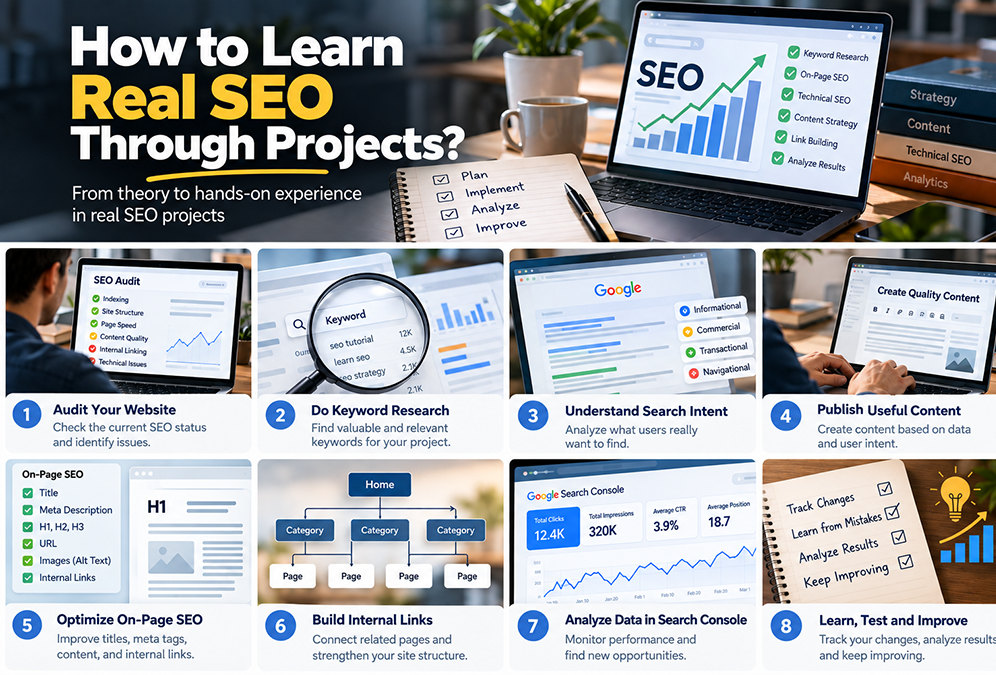
Step 1: Audit the Website
Before changing anything, you need to understand the current situation.
This usually starts with an SEO audit.
You should review areas such as:
Indexing
Site structure
Page speed
Important landing pages
Content quality
Internal linking
Technical SEO issues
Some useful questions include:
How many pages are indexed by Google?
Can search engines crawl important pages?
Is the robots.txt file blocking anything important?
Is the XML sitemap working correctly?
Are there broken pages or 404 errors?
Are redirects configured correctly?
Do pages have useful title tags?
Is duplicate content present?
Are important pages receiving internal links?
An audit gives you a clear picture of the website before you begin making changes.
Step 2: Perform Keyword Research on a Real Website
Keyword research is one of the most important SEO skills to practice.
Real keyword research is not only about finding terms with high search volume.
You also need to consider:
Search intent
Competition
Business value
The right page type
Relevance to the business
Current search results
Competitor strength
A keyword may receive thousands of searches every month but still provide little business value.
Another keyword may have lower search volume but attract users who are much more likely to become customers.
Practical SEO teaches you how to recognize that difference.
Step 3: Learn How to Understand Search Intent
One of the biggest differences between beginner and experienced SEO professionals is the ability to understand search intent.
Before creating content, you need to understand what users actually want when they search for a keyword.
Search intent can generally be:
Informational
Commercial
Transactional
Navigational
One of the easiest ways to understand search intent is to study the current search results.
Look at the pages ranking at the top of Google and ask:
What type of content is Google showing?
Are the results blog posts, product pages, category pages, landing pages, or comparison guides?
The results can help you understand what type of page users expect.
Step 4: Create Content Based on Data
A common SEO mistake is publishing a large amount of content without a clear strategy.
Before creating any page, you should know:
Which keyword the page targets
What the search intent is
What competitors are publishing
Which questions users have
What value your content can provide
The goal should not simply be to increase the number of blog posts.
Every piece of content should have a clear purpose within the website's SEO strategy.
Step 5: Practice On-Page SEO
On-page SEO is one of the best areas to practice on real websites.
For every page, you can optimize:
Title tags
Meta descriptions
H1 headings
H2 and H3 headings
URLs
Images
Image alt text
Internal links
Content structure
Related keywords and topics
However, optimization does not mean repeating the same keyword as many times as possible.
The main goal should be to make the page more relevant, useful, and easy to understand for both users and search engines.
Step 6: Take Internal Linking Seriously
Many beginners focus heavily on content and backlinks while ignoring internal linking.
Internal links can help search engines:
Discover new pages
Understand relationships between pages
Identify important content
Navigate the website structure
They also help users move between related pages.
On a real project, review whether your most important pages are receiving enough relevant internal links.
Step 7: Use Google Search Console as an Analysis Tool
Google Search Console is one of the most valuable tools for learning SEO in practice.
It can show you:
Which queries bring users to your website
Which pages receive impressions
Click-through rate
Average positions
Indexing issues
Search performance trends
But simply looking at the numbers is not enough.
You should ask questions.
For example:
Why does this page receive many impressions but few clicks?
Why did this page lose rankings?
Why is Google ranking this page for a different keyword than expected?
Why has this page not been indexed?
These questions are where real SEO learning happens.
Step 8: Document Your SEO Changes
One important habit in professional SEO work is documenting changes.
Whenever you make a significant change, record it.
Examples include:
Changing a page title
Publishing a new article
Updating internal links
Changing a URL
Updating content
Starting a link-building campaign
Fixing a technical issue
Later, you can compare these changes with performance data.
Without documentation, it becomes much harder to understand why rankings or traffic changed.
Step 9: Learn From SEO Mistakes
Mistakes are a normal part of learning SEO.
You may publish content that never ranks.
You may target the wrong keyword.
You may create a page with the wrong structure.
You may misinterpret search intent.
The important part is not avoiding every mistake.
The important part is learning from each one.
After every unsuccessful result, ask:
What did we change?
What result did we expect?
What actually happened?
Was our original assumption correct?
What should we test next?
This process builds SEO experience.
Step 10: Analyze Competitors Without Copying Them
Competitor analysis is one of the fastest ways to improve your SEO knowledge.
Websites already ranking well can provide valuable information.
You can analyze:
Topics they cover
Page structures
Keywords they target
Internal linking
Content formats
Landing page types
However, competitor research should not become copying.
The goal is to understand why certain pages perform well and how you can create something more useful for users.
A Practical SEO Learning Path
If you are just starting, you can follow a simple project-based learning path.
First, learn the basic SEO concepts.
Then create a small website.
Perform keyword research.
Create several important pages.
Publish useful content.
Connect the website to Google Search Console.
Wait for real performance data.
Analyze the results.
Improve your pages.
Repeat the process.
The key idea is simple:
Whenever you learn a new SEO concept, try to apply it to a real project as soon as possible.
How Long Does It Take to Learn SEO?
There is no exact answer.
The amount of time required depends on factors such as:
How much time you spend learning
How many projects you work on
How often you analyze data
The types of websites you work with
How much testing you perform
One person may spend a year watching courses but gain little practical experience.
Another person may work consistently on several projects and develop a much stronger understanding of SEO in a shorter period.
Instead of asking:
“How many months does it take to learn SEO?”
A better question is:
“How many real SEO problems have I worked on, and what have I learned from them?”
Can You Learn SEO Without a Real Project?
You can learn SEO concepts without having a website.
However, developing professional-level skills without practical experience is much more difficult.
If you do not have a client project, create your own website and treat it like a professional SEO project.
That website can later become part of your portfolio as well.
Real SEO Is About Problem-Solving
Professional SEO is not simply following a checklist.
Sometimes the problem is technical.
Sometimes the content is weak.
Sometimes the website architecture is poorly designed.
Sometimes competitors provide better information.
Sometimes search intent has been misunderstood.
Sometimes several problems happen at the same time.
That is why one of the most valuable skills for an SEO professional is the ability to analyze problems and find practical solutions.
Conclusion
If you want to learn SEO properly, you eventually need to move beyond theory and start working on real projects.
Courses, articles, and videos can teach you the fundamentals, but real experience comes from making changes, observing the results, analyzing the data, and improving your approach.
A useful SEO learning process looks like this:
Learn → Implement → Measure → Analyze → Improve → Repeat
The more often you repeat this cycle, the better you will understand search engines, users, websites, and SEO strategy.
Ultimately, an SEO professional is not someone who simply knows more terminology.
A strong SEO specialist is someone who can look at a website, identify problems, analyze data, develop reasonable solutions, implement improvements, and measure the results.
Frequently Asked Questions
Do I need my own website to learn SEO?
It is not required, but having your own website can make the learning process much faster. You can test strategies, publish content, and analyze real search data.
What is the best SEO project for beginners?
A small content website or personal website is a good starting point. Choose a topic you can consistently create useful content about.
Can I become an SEO specialist by taking courses?
Courses can teach you important concepts, but practical experience is essential if you want to develop professional SEO skills.
Which tools do I need to start learning SEO?
Google Search Console and Google Analytics are useful tools for beginners. As your skills and projects grow, you can start using more advanced SEO tools.
How can I gain SEO experience without clients?
You can start with your own website, work on small projects, create experimental websites, document your results, and use successful projects as portfolio examples.