
Google Just Changed AI Overviews and AI Mode: Will More Links Bring Website Traffic Back?
Google has updated AI Overviews and AI Mode with more prominent inline links, dedicated placements for official websites, expanded news carousels, richer related-article links and creator profiles. The changes could create new opportunities for publishers and brands — but they do not automatically mean organic traffic will return to pre-AI Search levels.

IN THIS ARTICLE Table of contents 11 sections
Google has made another significant change to the way websites appear inside AI Overviews and AI Mode.
This time, the focus is not a new ranking system or another AI model.
It is links.
On October 15, 2026, Google announced a group of changes designed to make it easier for people using AI Search to move from an AI-generated answer to websites, publishers, official sources and creators.
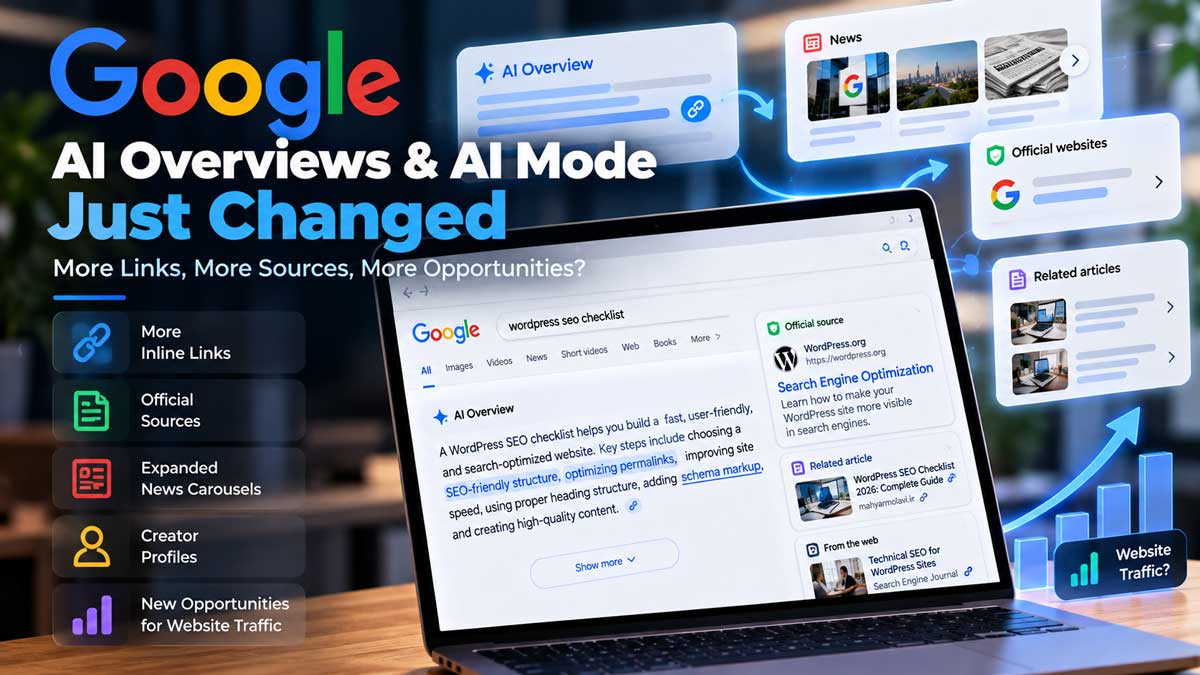
The update includes more inline links inside AI responses, links appearing higher in answers, a new section that can prominently surface official websites for certain queries, expanded news carousels, more visible related-article links and clickable creator or publisher profiles in some video results. blog.google
For website owners, this sounds encouraging.
More links should mean more opportunities to earn clicks.
But the important question is not whether Google is showing more links.
It is whether users will actually click them.
That distinction matters because AI Overviews and AI Mode are changing one of the oldest assumptions in SEO: that visibility in Google naturally leads to a website visit.
In AI Search, that relationship is no longer guaranteed.
What exactly did Google change?
The most important change is the continued expansion of inline links.
These are links attached directly to words or phrases inside an AI-generated response rather than placed only in a separate citation area.
Google says it has substantially increased the presence of these links and is now showing them higher in AI responses more frequently. blog.google
That placement matters.
A link near the beginning of an answer is likely to have a better chance of being noticed than one hidden at the bottom after the user's question has already been answered.
Google is also testing a new section that can surface one or two particularly relevant official pages near the top of an AI response.
Imagine a user asking how to perform a specific task with a product, apply for a service or find the correct official resource.
Instead of forcing that person to identify the authoritative website from several citations, Google may place the relevant official destination directly in front of them with context explaining why it is useful. blog.google
For brands, SaaS companies, government organisations and businesses with strong first-party documentation, this could become an important AI Search surface.
Google is also expanding prominent carousels for timely articles into more locations and languages globally. These carousels can highlight Preferred Sources, potentially giving news publishers and frequently updated websites more visibility when a query relates to a developing story. blog.google
The related-article area at the end of some AI responses is also becoming more visual, with image thumbnails and larger clickable treatments.
Finally, Google has begun testing clickable creator and publisher names on video results in AI Mode, connecting those names to Search profiles.
Taken together, the update makes AI Search look slightly less like a closed answer box and more like an interface that is trying to create multiple routes back to the web.
That is the optimistic interpretation.
Why is Google adding more links now?
This change did not appear in isolation.
Publishers, SEO professionals and website owners have spent much of the last two years asking what happens to the open web when Google answers more questions directly inside Search.
The concern is straightforward.
If a user can receive a complete answer from an AI Overview without opening a website, the publisher may contribute information to the Search experience without receiving the visit that previously followed.
Several third-party studies have reported lower click-through rates on searches where AI Overviews appear.
One 2026 analysis reported that pages cited inside AI Overviews still received more clicks than pages that were not cited, but both groups received lower CTR than comparable search results without an AI Overview. In that dataset, cited pages averaged roughly 2.1% CTR, compared with about 0.9% for non-cited pages and roughly 3.3% when no AI Overview appeared. Search Engine Land
Another publisher-focused analysis reported a substantial decline in traditional organic clicks after the expansion of AI Overviews across the sites it studied. That data should not be treated as a universal Google-wide number, but it illustrates why publishers remain concerned about the relationship between AI visibility and traffic. Search Engine Land
Google, meanwhile, has consistently argued that its AI Search products are designed to help users discover websites and continue exploring the web.
The company has already experimented repeatedly with link placement and richer website previews.
In an earlier rollout, Google said its testing showed that adding more prominent links inside AI Overviews increased traffic to supporting websites compared with the previous design, although Google did not publish enough absolute click data to determine how that traffic compares with traditional Search before AI Overviews. blog.google
That gap between “more clicks than the previous AI design” and “the same number of clicks websites received before AI Search” is extremely important.
They are not the same claim.
Will this update bring organic traffic back?
Probably not in the way many publishers hope.
It may increase click opportunities inside AI Search.
That is different from restoring the old Search model.
AI Overviews and AI Mode are intentionally designed to answer more of the user's question inside Google.
Even with more links, many users will still get enough information from the generated answer that they do not need to visit a source.
So I would not interpret this update as Google reversing AI Search.
The more useful interpretation is that Google is continuing to experiment with the balance between answering the question and sending the user to the web.
For SEO professionals, that creates a new competition.
Previously, the objective was largely to rank within the first several organic results.
Now there may be several different visibility surfaces on the same query:
Traditional organic ranking.
AI Overview citation.
Inline AI link.
Official-source placement.
Related-article card.
News carousel.
Preferred Source placement.
Creator or publisher profile.
The search result is becoming more fragmented.
That means SEO success may no longer be adequately described by one ranking position.
The position of the link may become as important as the citation itself
This is one of the most important implications of the update.
Not every citation inside an AI answer has the same value.
A source linked immediately after an important claim near the beginning of an answer may receive much more attention than a source listed at the bottom of a long response.
The new changes appear to acknowledge that.
Google is explicitly moving some links higher.
This creates something I would describe as citation position competition.
It is not enough to ask:
“Was my website mentioned in the AI Overview?”
A better question is:
“Where was it mentioned, what information did Google use from the page, and was the link placed at a point where the user had a reason to click?”
This changes how AI Search visibility should be analysed.
Imagine two websites are cited in the same answer.
Website A supports a definition the AI response explains completely.
Website B contains original research that the AI response briefly references and invites the user to investigate further.
Both websites received a citation.
But the commercial value of those citations may be completely different.
That is why raw AI impressions should not become the next vanity metric in SEO.
Official websites may gain a particularly valuable advantage
The new official-source section may be one of the most commercially important parts of the update.
Google says it will test prominently displaying one or two official links when there are specific authoritative destinations that can help the user complete a task or find exact information. blog.google
That has obvious implications for brand searches.
Suppose someone asks:
“How do I cancel my subscription to Company X?”
“Where can I download Product Y?”
“How do I apply for Service Z?”
“Where is the official pricing page?”
A Search system does not need ten general articles in those situations.
The official website may be the best destination.
If Google becomes better at identifying and surfacing first-party pages for these queries, strong brand architecture becomes even more valuable.
The practical SEO lesson is simple.
Businesses should make important first-party information easy to find and understand.
Pricing.
Documentation.
Support.
Contact information.
Policies.
Product pages.
Service information.
Company details.
Do not bury important official information inside vague marketing pages and then expect AI Search to infer everything correctly.
Clear first-party content has value beyond traditional ranking.
It helps Search understand when your website is the authoritative destination.
News and fresh content may get another opportunity
Google's expanded timely-article carousels are particularly interesting for publishers and sites that regularly cover current developments.
Earlier in 2026, Google began introducing similar experiences to make fresh articles and original perspectives easier to discover.
The October update expands those carousels into more locations and languages. blog.google
This does not mean every blog should suddenly become a news site.
Publishing meaningless “breaking news” articles about every small industry announcement is not a good content strategy.
But it does increase the value of publishing genuinely timely content when your expertise gives you something useful to add.
The difference is important.
A weak article says:
“Google released an update. Here are the five things Google announced.”
A stronger article says:
“Google released this update. Here is what changed, which websites are affected, what we can verify so far, what remains unknown, and what I would change in an SEO strategy because of it.”
The second article provides analysis rather than repetition.
That is also much closer to the kind of Information Gain that modern SEO increasingly needs.
Preferred Sources could become more valuable than many site owners realise
Google also highlighted the continued growth of its Preferred Sources feature.
According to Google, the number of people using Preferred Sources has grown more than sevenfold since the beginning of 2026. blog.google
Earlier this year, Google said users were about twice as likely to click through to a website they had selected as a Preferred Source. blog.google
That introduces an interesting shift in SEO.
Historically, Search visibility was largely determined query by query.
Preferred Sources introduce a stronger relationship between audience loyalty and Search visibility.
If someone actively tells Google:
“I want to see more content from this website,”
that site has moved beyond being just another result.
This is closer to building a direct audience.
For publishers and expert-led websites, that makes Brand an even more important SEO asset.
People need to remember the site.
Trust it.
Return to it.
Possibly select it as a preferred source.
This is another reason why publishing dozens of generic articles written only to capture keywords is becoming less attractive.
Commodity content is easy to replace.
A source people intentionally choose is much harder to replace.
More links do not change the fundamental requirements for AI Search visibility
Website owners should be careful not to turn this announcement into another collection of supposed “AI SEO hacks.”
There is no new special markup announced here that guarantees an inline link.
There is no button that tells Google to place your article in the official-source section.
And there is no reason to rewrite every article into unnatural fragments hoping that AI Mode will cite more sentences.
Google's broader guidance for generative Search continues to emphasise the same underlying requirements that matter in Search generally: content needs to be crawlable and indexable, pages need to provide a good user experience, and websites should publish useful, unique information rather than commodity content. blog.google
The newer AI interfaces change where content may appear.
They do not eliminate the need for strong SEO fundamentals.
If Google cannot crawl your page, the new inline-link design does not help.
If your page says exactly the same thing as twenty stronger sources, adding another heading called “AI Overview Optimization” does not make it uniquely valuable.
If the user clicks and finds a slow, confusing page full of ads or generic content, earning the click did not solve the business problem.
The objective remains useful visibility followed by a useful visit.
What should SEO teams change after this update?
I would not rebuild an SEO strategy because Google changed the visual treatment of AI links.
I would, however, adjust what gets measured and where content investments are made.
First, identify the pages already receiving visibility inside generative Search.
Google's dedicated Generative AI performance report in Search Console is now available worldwide and shows impressions, pages, countries, devices and performance over time for generative AI features such as AI Overviews and AI Mode. Google for Developers
The important limitation is that this dedicated report is currently far stronger for visibility analysis than for answering the question publishers care about most: exactly how many clicks each AI citation generated.
That means Search Console data should be interpreted alongside normal organic traffic, landing-page behaviour, branded searches, conversions and whatever AI-referral data is available.
Second, review high-value pages through an AI Search lens.
Not by adding artificial AI-specific sections, but by asking:
Does this page contain something worth citing?
Does it provide first-hand experience?
Original examples?
Data?
A clear explanation?
A better comparison?
A useful tool?
A unique opinion supported by evidence?
If the only value of a page is that it rewrites information already available on several stronger domains, competing for AI citations will be difficult.
Third, strengthen first-party pages.
Your official service, product, documentation, pricing and support pages should clearly answer the questions customers actually ask.
Google's new official-source placement increases the potential value of those pages.
Fourth, treat fresh industry coverage selectively.
When an important development affects your audience, publish quickly — but add expert interpretation rather than copying the announcement.
Finally, connect AI visibility to business outcomes.
The goal is not to celebrate that a page received 50,000 AI impressions.
The real questions are:
Did people discover the brand?
Did qualified users visit?
Did branded Search increase?
Did leads increase?
Did the page assist conversions?
Did people return?
SEO still needs to create business value.
The new SEO funnel may be longer than one click
There is another possibility that traffic-based reporting can miss.
A user may see your brand cited repeatedly in AI Search without clicking immediately.
Later they search the brand directly.
Or visit through another channel.
Or choose the website as a Preferred Source.
Or return when they are ready to buy.
That means AI visibility may sometimes behave more like brand exposure than traditional organic traffic.
This makes attribution more difficult.
It also means the industry should avoid two opposite mistakes.
The first is saying:
“AI Search sends fewer clicks, therefore visibility there has no value.”
The second is saying:
“We received millions of AI impressions, therefore our strategy is working.”
Neither statement is sufficient.
The value sits somewhere between visibility, recognition, click-through and eventual conversion.
Businesses will need better measurement to understand it.
More links are good news — but they are not a return to the old Google
Google's October 2026 update is positive for website owners in one important sense.
The company is clearly continuing to invest in ways for AI Search users to discover and visit sources on the web.
More inline links, higher link placement, official-source sections, timely article carousels, richer related links and creator profiles all increase the number of potential pathways out of an AI answer. blog.google
But I would not describe this as the return of traditional organic traffic.
AI Search changes the user's journey too much for that.
Some questions will still be resolved directly inside Google.
Some clicks will move toward the sources that AI chooses to cite.
Some queries may produce new discovery opportunities that did not exist in the old ten-blue-links interface.
And some publishers will probably continue to experience lower click-through rates even while their content appears more frequently inside AI answers.
The opportunity for SEO is therefore not to fight for the old Search experience.
It is to become one of the sources worth showing in the new one.
That means technically accessible websites, original content, strong first-party information, recognised expertise, useful media, clear topical relationships and pages that give the user a reason to continue beyond the AI-generated summary.
Google is providing more places for those links.
Now the competition is for which websites earn them — and which links are valuable enough that users actually click.